Sensational States
Sensational States
Overview
It could be argued that architecture is fundamentally experienced through contrast – even though contemporary construction often results in atmospherically bland, homeostatic, unsenseable spaces.
The unnatural consistency and 'performance' of much of our contemporary environment sharply disregards what neuroscientist Michel Cabanac terms "Alliesthesia", the physiological role of sensory pleasure in helping us calibrate to the environments around us. Indeed our enjoyment of sensory delight may even be a vital perceptual and biological mechanism.
From this perspective we might consider the pleasures of a cool breeze or hot bath as small fragments of a design agenda interested in reconsidering deeper environmental relationships. What is the architecture that emerges as we amplify, modulate or blur these sensory signals?
Building on previous on-going interests in material systems, supply chains and civic space, UG07 invites students to pursue sensation - to resolve architectural experiences defined by heightened contrasts and fluctuating states of body, thermodynamics and energy.
We will embrace a primary function of architecture – the modification and moderation of habitable climates – to consider how rich, sensory propositions interact with the unavoidably urgent reality of ecological change and the rapidly shifting patterns of heat, winds and rainfall brought about by planetary warming.
People have a sense of warmth and coolness, a thermal sense. [...] As with all our other senses, there seems to be a simple pleasure which comes with just using the sense, letting it provide us with bits of information about the world around, using it to explore and learn, or just noticing. [...] When the sun is warm on my face and the breeze cool, I know it is good to be alive.
Lisa Heschong, Thermal Delight (1973)
Detail
Hyperspectral Images
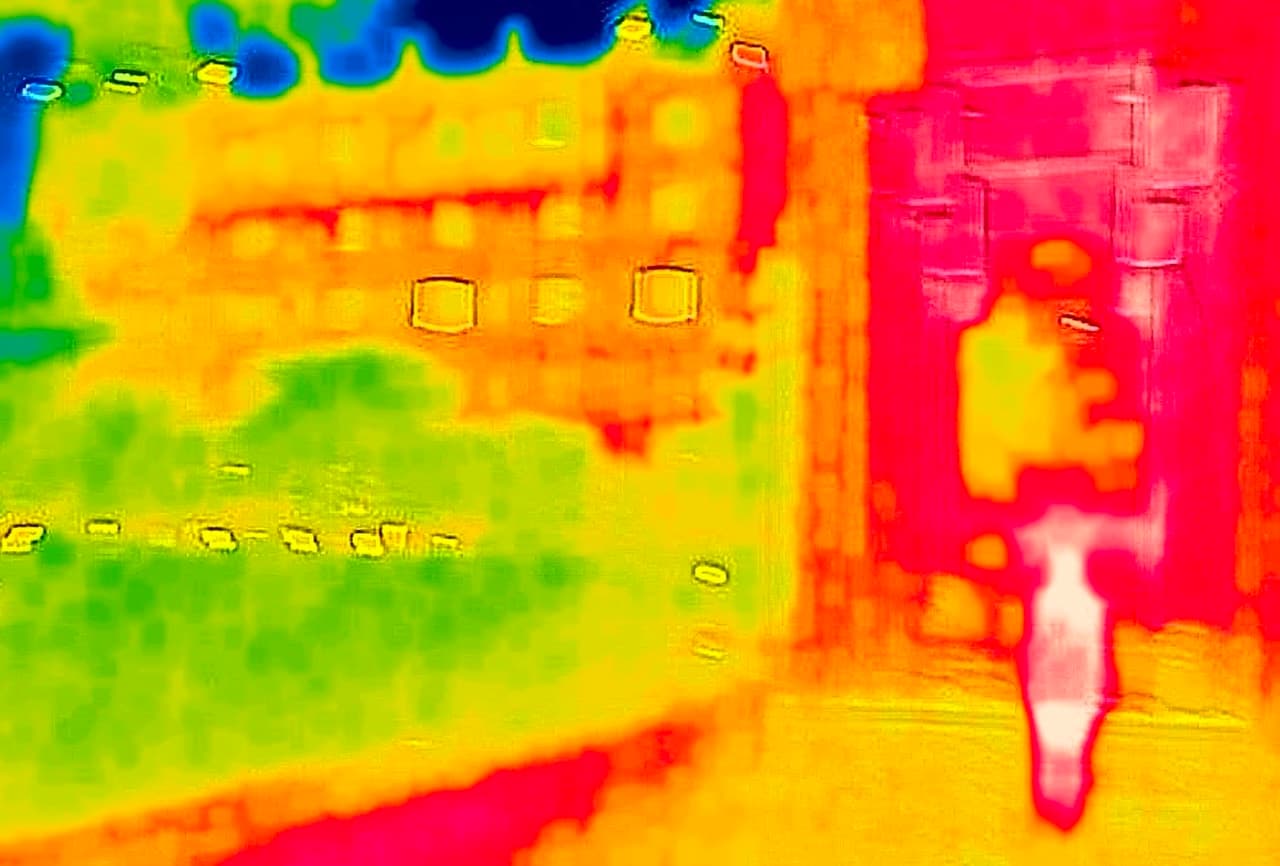
The colossal material flow of our globalised, planetary construction industry and the resulting patterns of ecological transformation are readily visible for those willing to look – or to sense – through countless new methods of digital processing. The hyperspectral images of the thermal camera, the points of a lidar scan or the gaze of machine vision. How we harness these emerging technological capacities to describe and inscribe new forms of drawing architecture and it's energetic impact will be a key consideration for the unit.
Boundary Conditions (P1)
For P1 students will be invited to develop a 'boundary condition' defining a sensory gradient and working in both digital and physical 1:20 making to produce a large scale building fragment alongside an articulation of it's architectural and and systematic consequences. The process will bring together investigations into the cultural and personal experience of sensation, the unpicking of material supply chains & the design of prototype methods for testing, calibration and physical making.
The Trip: Andalusian Alliesthesia
Our field trip will take us to Seville, Cordoba & Granada in Southern Spain, exploring the deep historical, political and social entanglements alongside their contemporary legacies. We will visit the site of the '92 Seville Expo, the Alcázar, the Cathedral, engaging with the legacy of Mudéjar architecture, the Mosque-Cathedral at Córdoba and culminating in a visit to the grand masterpiece of thermal architecture, The Alhambra. Each location will reveal diverse vernacular and contemporary architectural strategies for contending with Andalusia's intense summer climate.
Civic Urban Architecture (P2 & P3)
Site: Andalusia
In Term 2 and 3, we will ask students to develop a proposal for a civic building on urban sites visited during our trip. In Term 2 we will begin with the creation of spatial diagrams, before turning to using the section as a primary driver of the environmental locus of the building project, alongside a personal approach to media that students will be asked to delineate. In Term 3 the focus will shift to the development of the building as an integrated and atmospheric whole. How can we integrate our investigations into the expanded fields of sense towards, a deeper, somatosensory and thermodynamic engagement of the whole-body?
Physical & Digital Techniques
UG07 gives special priority to hand-sketching, spatial diagrams and physical making as key skills for architectural communication. Alongside this we aim to support students in developing their own technical and digital languages using software including Rhino, V-Ray, Blender, Photoshop and Illustrator. This year we will also be supplementing the process with workshops covering Thermography, Photogrammetry & LIDAR, Grasshopper and advanced visualisation. Students are also encouraged to find experimental modes of working with emerging technologies which in recent years have included Machine Learning / AI, Unreal Engine, Figma as well as various scripting and professional simulation tools.
Systems & Tectonics
Buildings do not arrive in insolation but as the result of a complex interplay between material economies and social dynamics.
UG07 emphasises materiality as the generator of architectural form and language. We invite students to consider how their designs are physically made and to speculate experimentally through the lens of construction systems and tectonics.
We encourage students to work collaboratively and to consider themselves as a think-tank, researching emerging materials and techniques collectively and sharing their findings in the studio.
Mitigation, Adaption.. Other?
The context of these investigations is the unavoidably reality of global climate change and the uneven experience of its effects.
The scientific consensus implies that we must now consider both how to mitigate and reduce the impacts of the our energy and material consumption in parallel with the development of strategies to adapt and respond to their consequences.
For architecture to contribute to this task we must engage with social and vernacular precedent, scientific knowledge and the keen study of emerging technologies in search of ways to contend with a rapidly heating planet.